Tiny crystals in Earth’s crust have captured the movement of the Milky Way’s spiral arms

Milky Way above a rocky coastline

Dr Phil Sutton has collaborated with Prof Chris Kirkland, a geologist at the University of Curtin, Australia, to determine that the Solar System passing through the spiral arms of the Milky Way can be linked to changes seen in crystals in the Earth’s crust. Their research used measurements of zircon oxygen isotopes, which record the amount of melting in the Earth’s crust and how much the crust interacted with water from the Earth’s surface. This supports the theory that when the Solar System passed through the spiral arms of the Milky Way, it pushed more bodies like comets and asteroids towards Earth, increasing the number of impacts on Earth at these times and melting the Earth’s crust. Therefore, the evolution of Earth was likely influenced by our Galaxy at large! They have published their work in Physical Review Research and written about their discovery in The Conversation. It has also been reported in Forbes.
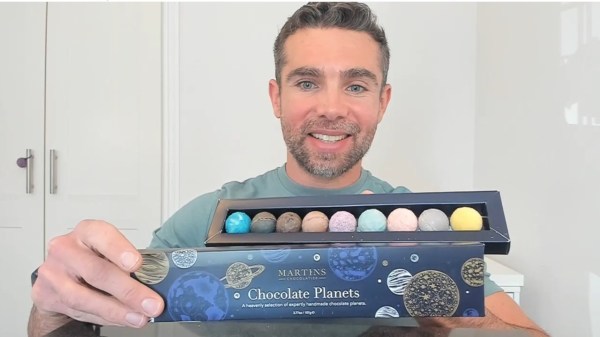
Exploring Planet Chocolates and Moon Diversity: A Solar System Taste Test by a Scientist

Join Dr. Phil Sutton, planetary scientist and Senior Lecturer in Astrophysics, on a unique journey where space meets flavour in two deliciously creative science videos. Ever wondered what the solar system might taste like? In this post, I blend astrophysics with artisanal chocolate to explore planets and moons through both science and flavour. With two videos, we’ll compare handcrafted chocolates to celestial bodies — from fiery planets to icy moons — using taste, texture, and a whole lot of planetary insight.

Planet-Themed Chocolates vs. the Real Solar System

I discovered a stunning set of chocolates modeled after the planets — from Mercury to Neptune (and yes, even the Sun!). In this tasty experiment, I compare each chocolate planet to its real celestial counterpart. How accurate are the colors & textures? Which ones pass the space test, and which are just sweet imposters?
👉 Check out the chocolates

Moons and Bonbons – A Cosmic Chocolate Pairing

In this second video, I take things deeper — literally — by pairing nine artisanal chocolates with nine of the solar system’s most fascinating moons. Each chocolate represents the unique characteristics of moons like Europa, Titan, and Enceladus, using flavour and texture to mirror their geology, heat, and icy shells.
👉 See the bonbons

From the swirling storms of Jupiter to the icy geysers of Enceladus, space is full of surprises — and so is chocolate. I hope these videos gave you a new way to experience the solar system, one bite at a time. Let me know your favourite flavour–moon combo, and stay tuned for more science you can taste!

Next Astro-Chat on 29th May 2025

The next Astro-Chat hosted by Professor Andrei Zvelindovsky at the University of Lincoln, with distinguished guest Professor Don Kurtz, will be held on 29th May 2025 at 7-8pm GMT, in which Don will discuss optical telescopes, including how they work and some of the most spectacular discoveries they have made. After the talk by Don, members of the public will be able to ask questions in the live-chat.

Book a place here: https://science-views.org/2025/05/25/xmas-astro-chat-big-glass-the-giant-telescopes/

You can also catch up with previous Astro-Chats using the YouTube Playlist above!

Start a Blog at WordPress.com.

Up ↑